


Bangkok Activists Call for Halt to Gas Expansion
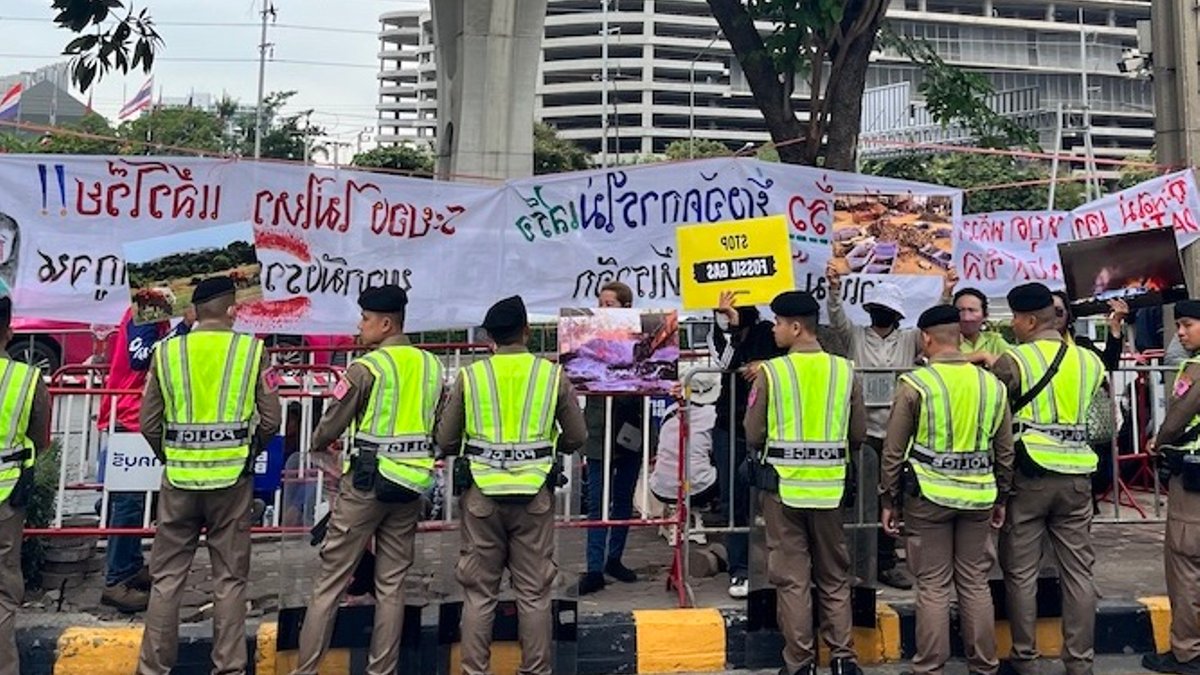
Climate activists in Bangkok are calling for an end to gas expansion in Asia, as billions of dollars in LNG and gas deals were agreed or announced at Gastech 2026, the world’s largest exhibition for natural gas, LNG, and other energy sector issues.
The event, held in Bangkok, generated an estimated $40 billion in energy agreements and investment plans, including a 20-year supply deal between US and Chinese firms, a $1 billion petrochemical investment in Sarawak, and $1.2 billion in shipbuilding orders for LNG carriers, according to The Nation.
Prime Minister Anutin Charnvirakul of Thailand greeted delegates from several leading global oil and gas firms, including Chevron and Shell, along with numerous energy providers from Thailand and across Asia.
Thousands of people attended the four-day event, but it was not without controversy, as a large group of angry protesters gathered outside the Bitec exhibition centre to express their feelings about the gas and energy sector executives in attendance.
Protesters Gather Outside
Elsewhere in Bangkok, environmental campaigners representing various Thai provinces and nations throughout East and Southeast Asia convened a public discussion aimed at devising ways to halt or withdraw financial support for upcoming gas extraction projects.
Resistance to the gas sector is increasing across numerous Asian regions, such as Thailand, where natural gas accounts for more than fifty percent of the country’s power generation.
For climate activists, the idea that gas is a “transition fuel” to replace coal-power plants and mitigate global warming is a misconception that needs to be challenged.
Member states of the G20 together with multilateral development banks continue to pour tens of billions of dollars into fossil-fuel projects, reportedly many times higher than the sums allocated to renewable energy.
Funding Fossil Fuel Expansion
Dawon Hwang, from Solutions For Our Climate (SFOC), said her group is focused on stopping Korean public money from funding fossil fuel expansion, citing the example of South Korean oil and gas companies leading nine projects in Vietnam, three in Indonesia, and one in Thailand.
The initiatives are expected to seek support from South Korea’s state-owned lenders. These lenders contributed roughly $5.7 billion annually to gas infrastructure between 2017 and 2024. This positions South Korea as the G20’s second-largest source of fossil-fuel financing.
Dawon observed that private banks now deem gas ventures too hazardous, yet when a government injects public capital, it can attract private investors who would otherwise stay distant, thereby allowing the project to proceed.
Yujung Shin of SFOC’s legal department highlighted a legal injunction. Tiwi landowners and a Korean activist filed it four years earlier. It targeted a $660 million stake in the Barossa gas project in the Timor Sea, north of Australia. This caused a regional court to cancel the drilling licence. It also resulted in Korean funding expiring in 2024.
She added that a $562 million Korean public allocation was earmarked for the Coral North FLNG venture in Mozambique. The plan faced opposition and legal challenges in Korea and Japan. This prompted two financiers from the UK and the Netherlands to withdraw $2.2 billion of anticipated funding.
Global legal norms are aligning. The International Court of Justice delivered a unanimous advisory judgment in July of the previous year. It stated that fossil-fuel subsidies lacking proper due diligence could amount to an unlawful act.
Yujung emphasized that putting money behind fossil fuel expansion carries legal consequences, and that climate activists are exploring multiple accountability strategies to challenge the gas industry.
A spokeswoman for Accountability Counsel (AC), a US-based group that defends the human rights and environment of marginalized communities harmed by internationally financed projects, said they have employed people-led strategies to counter harmful gas and energy projects.
Banks Commit to Fossil Companies
Sutharee Wannasiri, AC’s senior communities associate, told the forum that according to Banking on Climate Chaos, the world’s 65 largest commercial banks committed $906 billion to fossil companies in 2025 – a $108 billion increase from 2024.
The study noted that since the Paris Accord’s adoption ten years prior, banks have directed $8.7 trillion toward oil, gas, and coal activities. JP Morgan Chase, Mitsubishi UFJ Financial, and Citigroup ranked as the top three institutions supporting fossil-fuel corporations.
Only eight commercial banks have grievance mechanisms to process complaints from affected peoples. Public financial institutions contribute taxpayer money to fossil fuel gas expansion. Multilateral development banks provide at least $19 billion annually for oil, gas, and coal projects.
Sutharee noted that money can be leverage for local communities. These communities are often silenced by powerful energy corporations. Dozens of multilateral development banks have an Independent Accountability Mechanism. This mechanism handles complaints from people negatively affected by projects.
She suggested that institutional investors can influence corporate behavior. They can strengthen good governance, social, and environmental performance. This can be done by developing criteria for financial exclusion lists. Such lists can shift the balance of power between communities and corporations.
As of 2024, about 2,900 companies have been excluded in the climate category worldwide. This includes 260 companies in ASEAN nations. Specifically, 127 Indonesian, 22 Philippine, and 34 Thai companies were excluded. Their operations involved oil, gas, and coal production or contributed to greenhouse gas emissions.
Exclusion Lists Grow
In overall exclusion categories, 53 Thai companies were excluded from portfolios. These portfolios were drawn up by 59 investors from 14 countries. Most excluded companies were from the energy sector. Exclusions were based on climate impacts, human rights violations, and controversial business practices.
Climate activists continue efforts to stop gas expansion in Asia. They focus on targeting money and using accountability mechanisms to challenge the gas industry. Dawon Hwang emphasized, ‘The money came from Korea, so the decision to stop must come from Korea too.’ Hwang also stated that fossil fuel expansion is not inevitable but a choice. It can be challenged through strategic action.


